Photodiode Measurement
Low-noise current measurement for photodiodes and optical detectors.
View Application →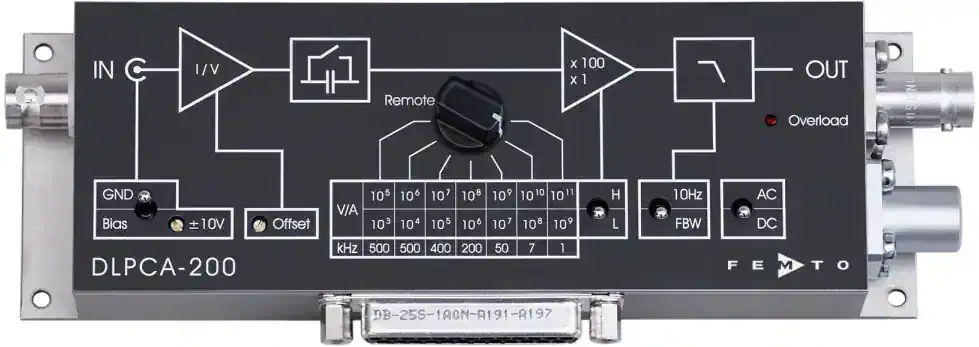
femto
Transimpedance (gain) switchable from 1 x 10³ to 1 x 10¹¹ V/A
PRODUCT OVERVIEW
OFFICIAL DOCUMENTS
Official technical documents provided by femto.
AI PRODUCT ASSISTANT
Ask technical questions about this femto product. An official datasheet is connected.
TECHNICAL SPECIFICATIONS
APPLICATIONS
Common measurement applications where this product can be effectively used.
Low-noise current measurement for photodiodes and optical detectors.
View Application →Sensitive current detection for avalanche photodiode measurement systems.
Precision optical signal acquisition for spectroscopy experiments.
PRODUCT COMPARISON
PRACTICAL ENGINEERING GUIDANCE
Practical setup guidance, measurement cautions and application notes for this product.
Begin measurement with a lower transimpedance gain and increase it gradually while checking the amplifier output for saturation, offset and unexpected signal peaks.
Source: manufacturer
Available bandwidth generally changes with the selected transimpedance gain. Confirm that the chosen gain setting satisfies the required signal bandwidth before finalizing the measurement configuration.
Source: manufacturer
A longer detector cable adds capacitance and can affect noise, stability and response speed. Keep the high-impedance input connection as short as practical.
Source: manufacturer
Multiple ground connections can create circulating currents and increase interference. Review the complete detector, amplifier, oscilloscope and power-supply grounding arrangement.
Source: manufacturer
Contamination and moisture around high-impedance input connectors can create leakage current. Keep connectors and adapters clean, dry and free from conductive residue.
Source: manufacturer
FEMTO states that the DLPCA-200 maintains a flat response for source capacitances up to approximately 1 nF without requiring external frequency compensation. Nevertheless, detector and cable capacitance should still be considered when evaluating noise and the complete measurement system.
Source: manufacturer
Gain selection and several operating functions can be controlled through opto-isolated digital inputs. This is useful for automated measurements because it reduces direct electrical coupling between the control system and the sensitive amplifier.
Source: manufacturer
The DLPCA-200 includes an overload indication. Begin measurements at a lower gain, observe the output and overload status, and then increase gain only when sufficient output headroom remains.
Source: manufacturer
TECHNICAL RESOURCES
LABTECH KOREA
Contact our engineering team for quotations, application support, product comparison and technical consultation.
Request a Quote →